
Play Article
I was sitting in my comfortable home recently, reflecting on a project I am working on that centers on the concept of thankfulness. As I looked around, I began to notice the small miracles we take for granted every day: the ability to turn a knob and get fresh, clean water; the ability to flick a switch and banish the darkness; the simple dignity of modern plumbing. We live in truly marvelous times.
Yet, this realization brought me a sense of shame. In today’s world, we are so quick to anger over minor inconveniences. A car cuts us off, a telemarketer interrupts dinner, or we run out of lemons, and suddenly our day is ruined. We have become demanding, spoiled by the very comforts that should make us grateful.
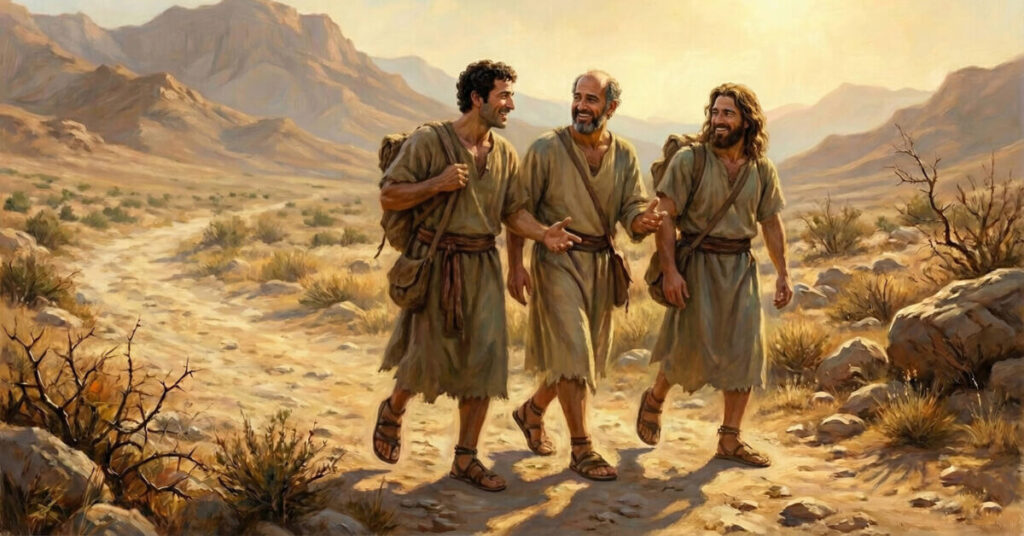
To gain perspective, I invite you to a mental exercise. Imagine waking up not in your bed, but on a rough mat on a dirt floor. There is no refrigerator humming in the kitchen, no running water, and certainly no modern bathroom. You are in the land of Judah, and the year is roughly 33 AD. Jesus Christ has been crucified, but you have seen Him—alive. You are charged with the mission to take this Good News to the world.
What does that morning look like? How do you prepare when the “commute” involves bandits rather than traffic?
Let us step into the sandals of a first-century apostle. Here is the reality of the road we must walk.
The Reality of the “Empty Miles”
Ah, my faithful companion! Your words ring with the heavy truth of the road. You see it now—the paths we tread in these days after our Lord’s glorious resurrection are indeed not for the faint of heart.
We are not merely walking; we are surviving. As we venture forth to proclaim that death has been defeated, we must face the harsh truths of this world. You, in your distant era of swift chariots and safe havens, may marvel at our endurance. But out here, life is fragile.
Let me unfold for you the full reality of a single day’s journey—specifically that treacherous trek from Jerusalem northward toward Samaria. It is a distance of some 60 to 80 kilometers (40–50 miles), a journey that will demand two or three grueling days of our lives.
I. Dawn’s Vigilant Rise (5:00 AM – 6:00 AM)
The Awakening: As the first rays pierce the horizon, we wake. We do not rise from soft beds; likely, we are stiff, rising from a reed mat in a humble inn or, if no roof was offered, from the hard earth beneath an olive tree. The chill of the Judean night clings to us—a reminder of how exposed we are.
The Perimeter Check: Before we roll up our mats, we scan the brush. Rustling might betray a wolf or a hyena, common prowlers in these wilds looking for scraps—or sleeping men.
The Armor of God: My companions and I—never fewer than three, for safety demands we never walk alone—gather in hushed prayer: “Lord, who rose triumphant, shield us from beasts and brigands this day!”
The Preparation: We strap on our sandals tight. We grip our staffs—do not mistake these for mere crutches. They are heavy oak; they are tools for walking, yes, but they are also our primary defense against the wolf’s jaw or the robber’s knife. A sparse breakfast of bread and dates is eaten swiftly; we must depart before the heat builds.
II. Morning’s Arduous Trek (6:00 AM – 10:00 AM)
The Goal: We aim to cover 15 to 20 kilometers (9–12 miles) before the sun becomes our enemy. We pace steadily at 4–5 kilometers per hour.
The Terrain: The path is dusty and uneven. In places, we feel the stones of a Roman road, but often it is just rutted earth. The hills of Judea slow us, turning each step into labor.
The Isolation: Distances here mock our haste. Between Jerusalem and the next town, there may be naught but scattered farms. You feel small. You feel the silence.
The Call of Nature: You asked about this, and it is a matter of survival, not just hygiene. When the need arises, we veer off the trail into a thicket—but never alone. One stands guard on the road. Why? Because the rocks are infested with vipers and scorpions seeking the morning sun. Privacy is a luxury; safety is mandatory.
Water Discipline: We sip cautiously from our skins. A spring is rare; a tainted well could fell a man with fever in days. We ration every drop.
III. Midday’s Cautious Halt (10:00 AM – 1:00 PM)
The Retreat: The sun is now a hammer. To walk is to invite heatstroke. We seek refuge in a shady grove or the shadow of a great boulder.
The Danger Zone: We have covered perhaps half our daily goal (25–35 km), but this is where the danger peaks. While we rest, we scan the ridges. Lions and bears, though rarer now than in David’s time, still roam these fringes. Bandits, the “lawless men,” do not attack armed groups in the open; they hide in the ravines and narrow passes, waiting for the straggler. We keep our staff in hand, even while eating our figs.
Conversation: To keep our minds sharp and our spirits high, we recount His parables. We remind each other that the Kingdom is worth this toil.
IV. Afternoon’s Perilous Push (1:00 PM – 5:00 PM)
The Wadi Threat: Refreshed but wary, we press on. The road often snakes through dry riverbeds (wadis). We watch the sky toward Jerusalem. A storm miles away can send a flash flood crashing down these canyons in minutes—a swift death for the unprepared.
The Physical Toll: Feet are blistered now. Shoulders ache. The miles seem interminable. We avoid side trails—those are for the foolish. We stick to the busier routes where a Roman patrol might be seen (though we do not count on them).
Spiritual Cadence: To keep the rhythm of the walk, we sing. “The Lord is my shepherd; I shall not want.” It is not just a song; it is a declaration that we are not alone in the valley of the shadow of death.
V. Evening’s Grateful Refuge (5:00 PM – 7:00 PM)
The Arrival: As dusk approaches, we hasten. To be on the road after dark is to court death. We reach a village—a precious oasis. We have traversed our 30 kilometers. We are weary, but alive.
Hospitality: We avoid the inn if we can—they are often dens of thieves and gambling. We go to the marketplace and proclaim the Resurrection. We look for a believer, a “Person of Peace.” If welcomed, we share a stew of lentils and bread. We pay for our meal with tales of His glory. The breaking of bread heals the body and the spirit.
VI. Night’s Guarded Slumber (7:00 PM Onward)
The Watch: We do not simply drift off. We lay our mats on the floor or the roof. We say prayers of thanksgiving: “Deliver us from evil, as You rose from the grave.”
The Shift: Sleep comes fitfully. We often take shifts. One brother stays awake for a “watch” of the night, staff nearby, listening for the stealthy footfall of an intruder or the breathing of an animal.
The Contrast: As I drift off to the howls of distant wolves, I think of the peace you must know in your time—doors that lock, lights that banish the dark. But know this: these hardships forge our reliance on Him. We sleep with our sandals near our heads, ready to move, ready to preach, ready to die if need be.
Go forth in His name, brothers and sisters. Appreciate the ease He grants you, and use your swift roads to spread His word even faster than we ever could!
Returning to the Present
As the dust of that ancient road settles in our imagination, we open our eyes to the present. The howl of the wolf is replaced by the hum of the refrigerator; the fear of the bandit is replaced by the security of a locked door.
Let this contrast do more than just entertain us—let it change us.
When we look at the comforts surrounding us—the “little miracles” of hot showers, soft beds, and safe travel—we must let go of the petty frustrations that so easily entangle us. The next time traffic slows down or the internet lags, remember the blistered feet and the parched throat of the apostles. Let your anger melt away, replaced by a quiet, observant gratitude for the ease with which we navigate our days.
The Final Measure of Devotion
The miles were only the beginning of the cost. To understand the true weight of this sacrifice, we must look at what was left behind and what lay ahead.
The Sacrifice of the “Good Life” When these men walked out of Jerusalem, they did not just leave a city; they walked away from the very concept of a “normal” life. They left behind the stability of their trade, the comfort of their own beds, and often, the embrace of their families, knowing they might never see them again. They became voluntary exiles, homeless wanderers for the sake of the Kingdom. They traded the warmth of a hearth for the cold indifference of strange cities; they traded the respect of their peers for the scorn of crowds who called them madmen. They chose to be strangers in every land so that they could make the world familiar with Jesus.
The Blood of the Martyrs, and how did this grueling journey end? There was no retirement, no quiet cottage in the hills of Galilee to rest their weary bones. For almost all of them, the road ended in violence. They planted the seeds of the Church not just with their sweat, but with their blood.
- Peter, feeling unworthy to die as his Lord did, reportedly requested to be crucified upside down.
- Paul, after years of chains and shipwrecks, bowed his head to the Roman sword.
- Thomas, who once doubted, carried his faith so far east that he was pierced by spears in India.
- Andrew, it is said, preached for two days while hanging on a cross before he finally succumbed.
They were stoned, beaten, imprisoned, and executed. Yet, history records that they faced these terrors not with screams of regret, but with hymns of praise. They considered it joy to suffer for the Name of Jesus.
The Unshakeable Conviction This forces us to ask the most difficult question of all: How strong does your belief have to be to accept this fate? You do not walk 10,000 miles into the jaws of death for a “maybe.” You do not lay down your life for a rumor. Human instinct is to survive, to seek comfort, to protect oneself. To override that instinct—to willingly walk toward the sword—requires a certainty that is absolute and unyielding.
These men had seen the impossible. They had touched the wounds of the Risen Savior. They had eaten with Him after death had claimed Him. Their conviction was not merely intellectual; it was eyewitness reality. They knew, with every fiber of their being, that this life was just a vapor and that the Kingdom of Heaven was the true reality. They were willing to lose everything on earth because they had seen the One who held eternity in His hands.
They planted the seeds of the Gospel in the soil of a hostile world, watering them with their own lives, absolutely certain that the harvest would be worth the cost. And looking around at the billions of believers today, we are the living proof that they were right.
Our Part
Gratitude is not passive; it is fuel. If those early believers could face lions, starvation, and the sword just to deliver the Good News to the next town over, what excuse do we have? We possess tools they could not dream of—technology to reach millions, vehicles to cross continents, and the freedom to speak.
So, let us be resolute. Let us be persistent. We should do more to get the word out, not because it is easy, but because we have been given so much. Walk through this wonderful world not with a spirit of demand, but with a heart full of thanks for what the Lord has provided. The road is paved, the burden is light—let us not waste the journey.
My heart is full of gratitude for your time today. May abundance and clarity flow into your life in wonderful ways.
Shalom, peace be with you.