
Play Article
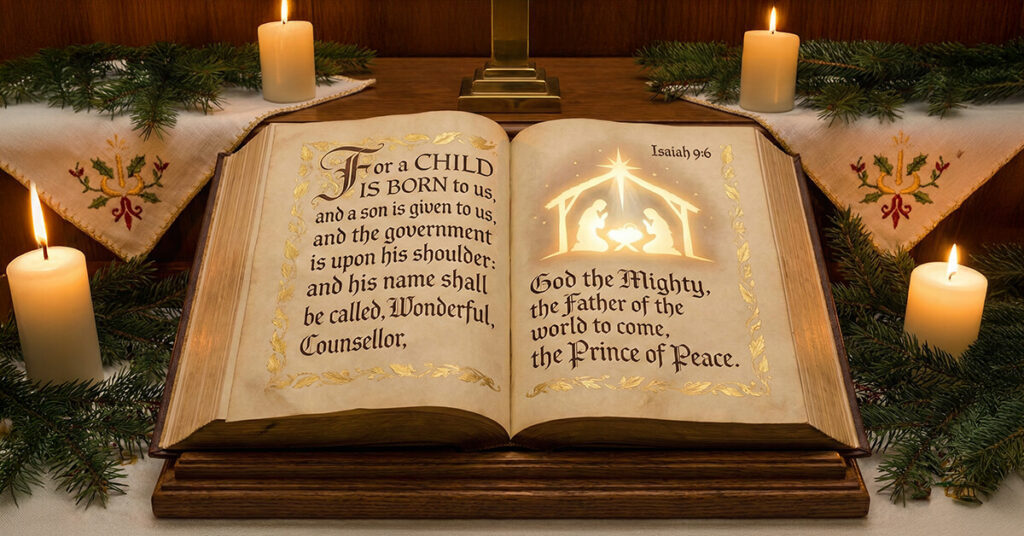
“For a CHILD IS BORN to us, and a son is given to us, and the government is upon his shoulder: and his name shall be called, Wonderful, Counsellor, God the Mighty, the Father of the world to come, the Prince of Peace.” (Isaiah 9:6) – 734–730 BCE
Isaiah 9:6 is much more than an old prophecy or a poetic phrase. It is a powerful statement and one of the first signs in the royal psalms of God’s promise to send a Savior. Many see it as an early glimpse of the good news, a moment when God’s plan to help humanity with its struggles begins to take shape.
At its core, this passage delves into the essence of who Jesus of Nazareth truly is, offering a blend of mystery and deep comfort that speaks to the heart.
The Twofold Reality: Born as a Child, Given as a Son
The opening words show what many believe is the heart of Jesus: he is both fully human and fully God, joined together in one person without confusion.
“For unto us a child is born” points to his true humanity. He is not a distant idea or a faint spirit. He comes into the world through Mary and shares in our weaknesses and daily struggles.
Next, “unto us a son is given” points to his divine nature. The child is born, but the Son is given, showing that he has always existed with the Father. This is God’s greatest gift to a world in need, similar to what John 3:16 says about love and sacrifice.
The Weight of Authority on His Shoulders
Over the years, scholars have understood this image in a few important ways, using early teachings and art as their guide.
One view links it to the cross. Early thinkers believed it pointed ahead to Christ’s suffering. Like a leader carrying a symbol of power, Jesus took on the weight of human sin and its results.
Another view sees it as a sign of his rule over everything. In a world that can feel unstable, this reminds us that the one who holds all things together is also our redeemer.
The Messiah’s Four Titles
These names answer important questions about who Christ is, not just what he does.
Wonderful Counselor shows that he is the source of wisdom and the divine Word. He does not just give advice; he shows us the way to real life. In John’s Gospel, he is the one who reveals God. This title reminds us that his wisdom goes beyond ours and leads us to hope when we are confused.
Mighty God confirms that he is truly divine. Jesus is not just a wise teacher or a messenger; he is God himself. This gives us confidence in his power to defeat darkness, death, and brokenness. Only this kind of strength can bring real healing to everyone.
Everlasting Father can be confusing at first because of the differences in the Trinity, but it speaks to how he cares for us like a loving parent. As the source of eternal life, he looks after and protects those who belong to him, just as Hebrews promises his constant care and support.
Prince of Peace is the final title. Sin separates us from God, but Jesus closes that gap by his life and death. As Romans says, when we trust in him, we are brought back to God and find a deep sense of wholeness in every part of our lives.
Reflections Through the Ages
Over the centuries, this verse has inspired many important people of faith.
St. Irenaeus of Lyons (c. 130–202) St. Irenaeus used this verse as a shield against early heretics who tried to deny Christ’s humanity. He argued that the prophecy perfectly excludes all error: the phrase “Child born” proves He was truly human and born of flesh, while the title “Mighty God” proves He was truly divine. For Irenaeus, this verse established Jesus as the perfect bridge—the union of the created and the Uncreated.
St. Augustine of Hippo (354–430) St. Augustine marveled at the humility found in this text, meditating on how the “Mighty God” reduced Himself to a tiny infant. He preached on the beautiful paradox that the One who directs the stars was now nursing at the breast, and the “Everlasting Father” became a Son in time so that human beings might become sons of God for eternity.
St. Thomas Aquinas (1225–1274) St. Thomas applied his intellect to the title “Wonderful,” explaining that it signifies the suspension of the laws of nature. He taught that the birth was “wonderful” because it exceeded human understanding on two counts: that a Virgin should give birth, and that the Infinite God should take on a finite form, striking the human mind with holy awe.
Cornelius a Lapide (1567–1637) Cornelius a Lapide focused on the Vulgate translation “Father of the World to Come.” He distinguished this from God the Father, explaining that while Adam was the father of a world of sin and death, Christ is the Father of a new spiritual lineage. He taught that Jesus begets believers into this new age through Baptism and sustains them with the Eucharist.
Martin Luther (1483–1546) Martin Luther focused on the words “unto us,” saying that it is not enough to know these truths in your mind—you must make them your own. “He’s my Counselor, my Mighty God,” he would say, encouraging people to live out their faith in a personal way.
George Frideric Handel (1685–1759) George Frideric Handel brought this verse to life in his Messiah oratorio, turning it into a joyful song with uplifting music that fills listeners with awe and thankfulness for God’s closeness.
Charles Spurgeon (1834–1892) Charles Spurgeon found comfort in this verse for people going through hard times. He advised turning to the Counselor when you are confused, relying on the Mighty God when you are tired, coming close to the Everlasting Father when you feel alone, and finding rest in the Prince of Peace during trouble.
In the end.
Isaiah 9:6 sums up the gospel in one strong message: God, once far away, comes near by entering our world as a newborn. It reminds us that the ruler of everything is also our caring Savior, bringing strength and peace to those he loves.
My heart is full of gratitude for your time today. May abundance and clarity flow into your life in wonderful ways.
Shalom, peace be with you.